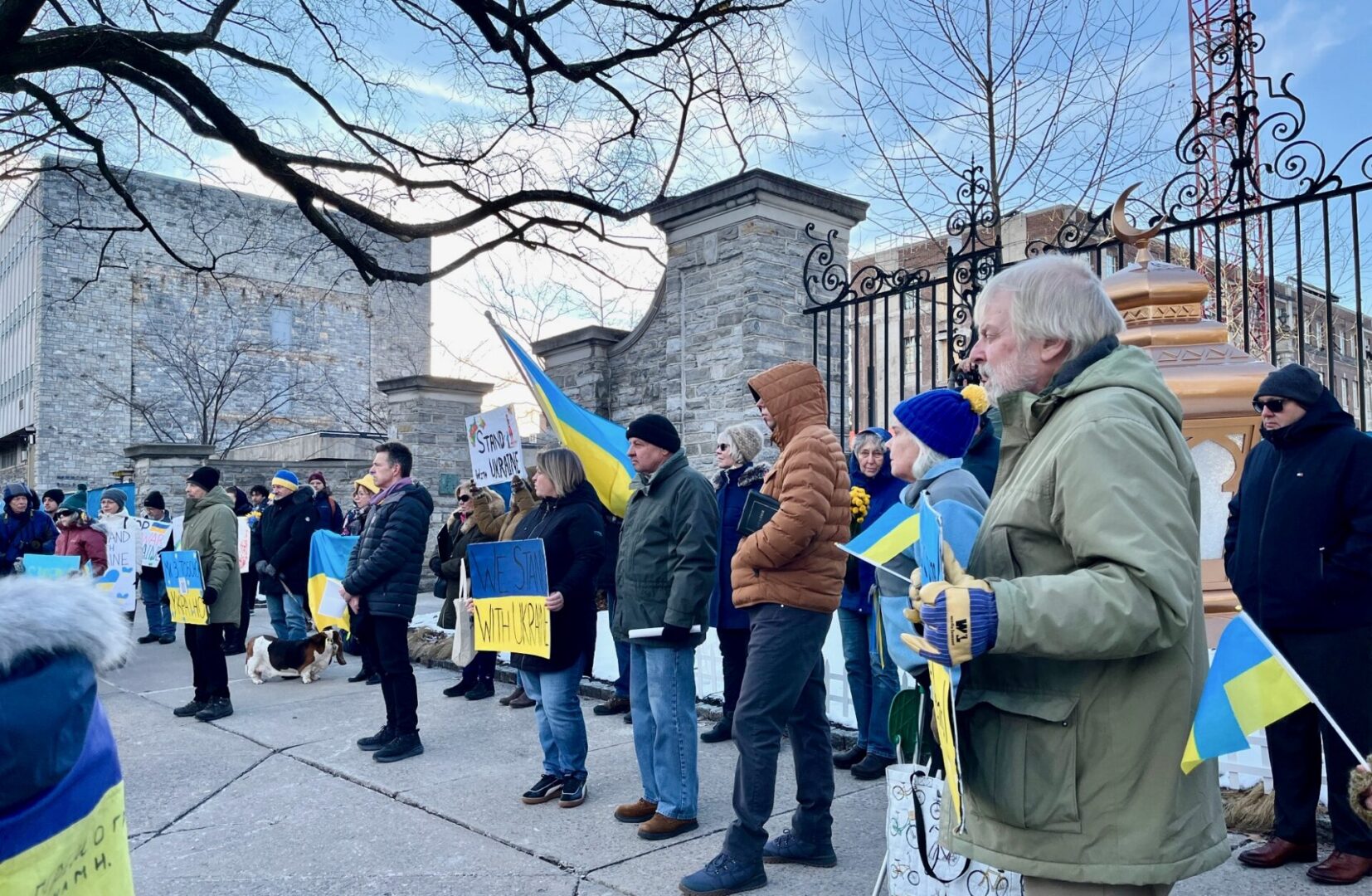
If you’re like me, at some point this winter, you complained about the relentless cold. But consider what it’s been like in Ukraine, where it was just as frigid not just outside, but indoors, thanks to a relentless Russian assault on the power grid.
If you were living in Ukraine this winter, Svitlana Budzhak-Jones told me, you might have slept in a fur coat in a sleeping bag under 15 blankets. You might have frantically laundered, cooked, baked and charged your phone when the electricity came back on, only for the power to cut out again before you’d finished any of those tasks. At which point you and your neighbors might have built a bonfire in the street and warmed yourself by dancing and singing the night away.
She’s not sure why, but Budzhak-Jones, the longtime State College resident who has been coordinating local relief efforts for her compatriots, is feeling optimistic about the war. Maybe it’s because it’s spring, unofficially, and Ukrainians have survived all that cold and all those Russian missiles and drones. Maybe it’s because Iran, Russia’s supplier of drones, is now otherwise engaged. Maybe it’s because her people have suffered too much to quit now.
Yes, four years into the Russian invasion, Ukrainians are exhausted. But surrender is still not an option, Budzhak-Jones says – not when you consider how the Russians might behave as conquerors.
“If they come in, there will be no justice,” she says. “They will find a way to punish people.”
I chatted with Budzhak-Jones and her sister, Oleksandra Pyrozhok, on Zoom a couple of days ago, interested to hear how they were holding up as the war enters its fifth year. Svitlana was in Germany, translating for NATO’s Ukraine mission. Oleksandra was in State College, where she came as a refugee from the war in 2022. Her husband joined her here the following year. Their adult son moved to Israel last year – from one war zone to another, Oleksandra says.
When I spoke to Oleksandra 18 months ago, she was grateful to have landed in a safe place, though she missed her home in western Ukraine. “It’s still hard,” she says, but she and her husband have a life in State College now and aren’t sure they would go back to Ukraine if the war ended.
At the same time, their situation is none too secure here. Temporary Protected Status for Ukrainians fleeing the war ends this fall and there’s been no indication from U.S. Citizenship and Immigration Services that it will be extended. Given the prevailing anti-immigration climate, there’s reason to be concerned. Leaving the United States for another country, Oleksandra says, would mean “starting from zero”: having to find work and a place to stay, only this time, among strangers.
Meanwhile, in Ukraine, the casualties mount. Close to 14,000 civilians have died since the invasion began and perhaps 10 times that many soldiers – possibly more (as is ever the case in wartime, the numbers vary depending on who is doing the counting). One thing’s for certain: The longer the war goes on, the deeper the Ukrainian military has to dip into the civilian population for conscripts. Svitlana tells me her 56-year-old cousin was just called up.
Casualties (and costs) on the Russian side are much higher. By any measure, this “special operation,” as President Putin still calls it, that was supposed to be over in a matter of days, has been a full-blown catastrophe. Since it’s hard to imagine Putin admitting as much, one wonders if the only way the war will end is if Russian elites rise up, oust him from power, and bring the troops home.
Hard to imagine, perhaps, but there’s no end to the hard-to-imagine things happening in the world at present.
Last Wednesday night, I caught the Oscar-nominated short documentaries at the State Theatre. The only one of the five films that wasn’t relentlessly bleak was the one without any humans in it: The stars of “Perfectly a Strangeness” were three donkeys.
The other films were about a perpetually besieged abortion clinic in Atlanta (“The Devil Is Busy”), Israeli vigils for Palestinian children killed in Gaza (“Children No More: Were and Are Gone”), a photojournalist killed covering the war in Ukraine (“Armed Only with a Camera: The Life and Death of Brent Renaud”) and children killed in school shootings whose parents preserve their bedrooms as shrines (“All the Empty Rooms”).
Violence and the threat of violence everywhere. By the end of the evening, I felt pummeled. Now I’m writing about the Ukraine war while checking for updates on the Middle East war. How is it that we can still be such savages?
True, the films, like the war in Ukraine, also show us human resilience — a word Ukrainians are tired of hearing, according to The New York Times — even heroism. But why must we ceaselessly put people in situations where so much resilience and heroism are called for?